Retrieving…
Section VI · Institution
About NeuraKink
A credible institution with a hidden cultural life: rigorous enough to publish research, cinematic enough to create obsession, and strange enough to make knowledge itself feel seductive.

Editorial stance
NeuraKink publishes at the intersection of neuroscience, psychology and kink-positive practice. We write for experienced practitioners who already know the basics — people who want depth, not a 101, and who treat consent, safety and psychological nuance as first-class concerns.
The work is science-forward, practitioner-led, and deliberately unhurried. Claims are sourced. Plates are credited. Colour is classification. The darkness is atmospheric, not technological: a private research library after hours, not a dashboard.
What we publish
Four rooms, one subject
Each section of the institution has a job. The subject is the same.
The Journal
Long-form investigations, sourced and illustrated from the archive.
The Academy
Structured curricula on consent, communication, neuroscience and risk-aware practice.
The Directory
A working register of educators, organisations, resources and safety references.
Community
Events, forums and a reading room — the rooms around the work.
Masthead
The editorial board
Instructors of the Academy, listed as the people who stand behind the work. Composite portraits; no fabricated faces.
James Okonkwo
MA Clinical Psychology, 12+ years consent education
James specializes in translating consent theory into embodied practice. His work bridges trauma-informed care, negotiation frameworks, and real-time attunement skills for experienced practitioners.
Avery Holt
Certified Sex Educator, negotiation specialist
Avery designs structured communication frameworks for complex scenes and ongoing dynamics. They focus on making negotiation repeatable, not improvised.
Dr. Mira Chen
PhD Clinical Psychology, somatic trauma specialist
Dr. Chen integrates neuroscience, attachment theory, and somatic psychology into kink education. Her courses emphasize nervous-system literacy and window-of-tolerance awareness.
Dr. Elena Vasquez
PhD Neuroscience, sexuality researcher
Dr. Vasquez translates peer-reviewed research on arousal, attachment, and autonomic regulation into practical frameworks for practitioners who want evidence-based understanding.
Sam Rivera
RN, harm reduction educator, 15+ years community safety
Sam brings clinical nursing and community harm-reduction expertise to risk-aware play education. Their approach centers informed consent, not fear-based restriction.
Chronology
A chronology of the science of desire
The body was measured, drawn, photographed and mapped long before it was allowed to be understood. A selective timeline of the work this institution stands on.
1543
The body becomes something you can look at
Andreas Vesalius publishes De humani corporis fabrica in Basel. Anatomy shifts from commentary on ancient authorities to direct observation of dissected bodies, illustrated by artists working in the studio of Titian.
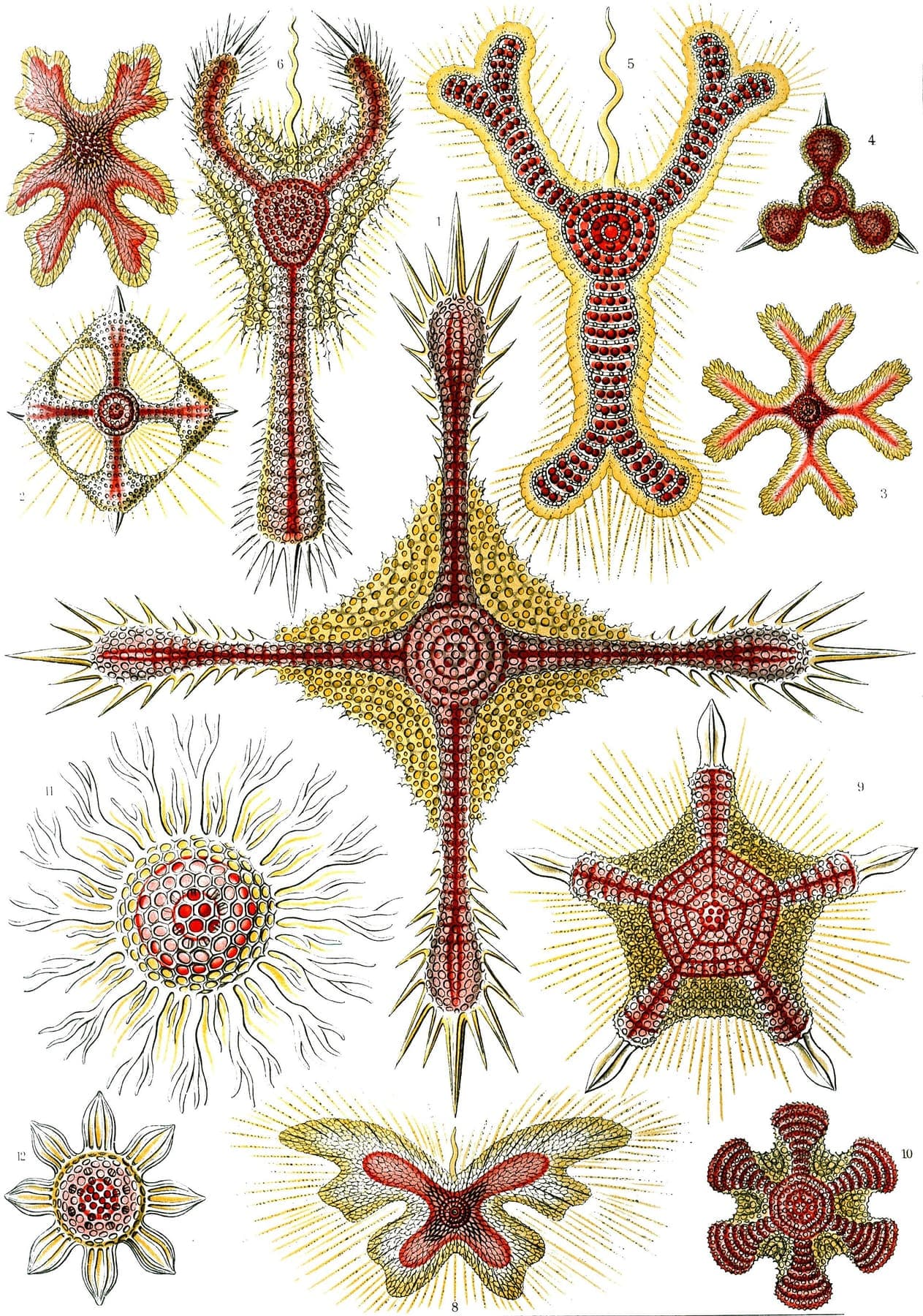
Discoidea — Kunstformen der Natur, Plate 31
1791
Nerves are electrical
Luigi Galvani publishes his commentary on the effect of electricity on muscular motion, reporting that an electrical stimulus makes a frog's leg contract. The nervous system begins to be understood as a signalling system.
1862
Expression is mapped, muscle by muscle
Guillaume-Benjamin Duchenne de Boulogne publishes Mécanisme de la physionomie humaine. Using localised electrical stimulation and the new medium of photography, he isolates the muscles behind individual expressions — and shows which ones cannot be faked.
1872
Emotion enters natural history
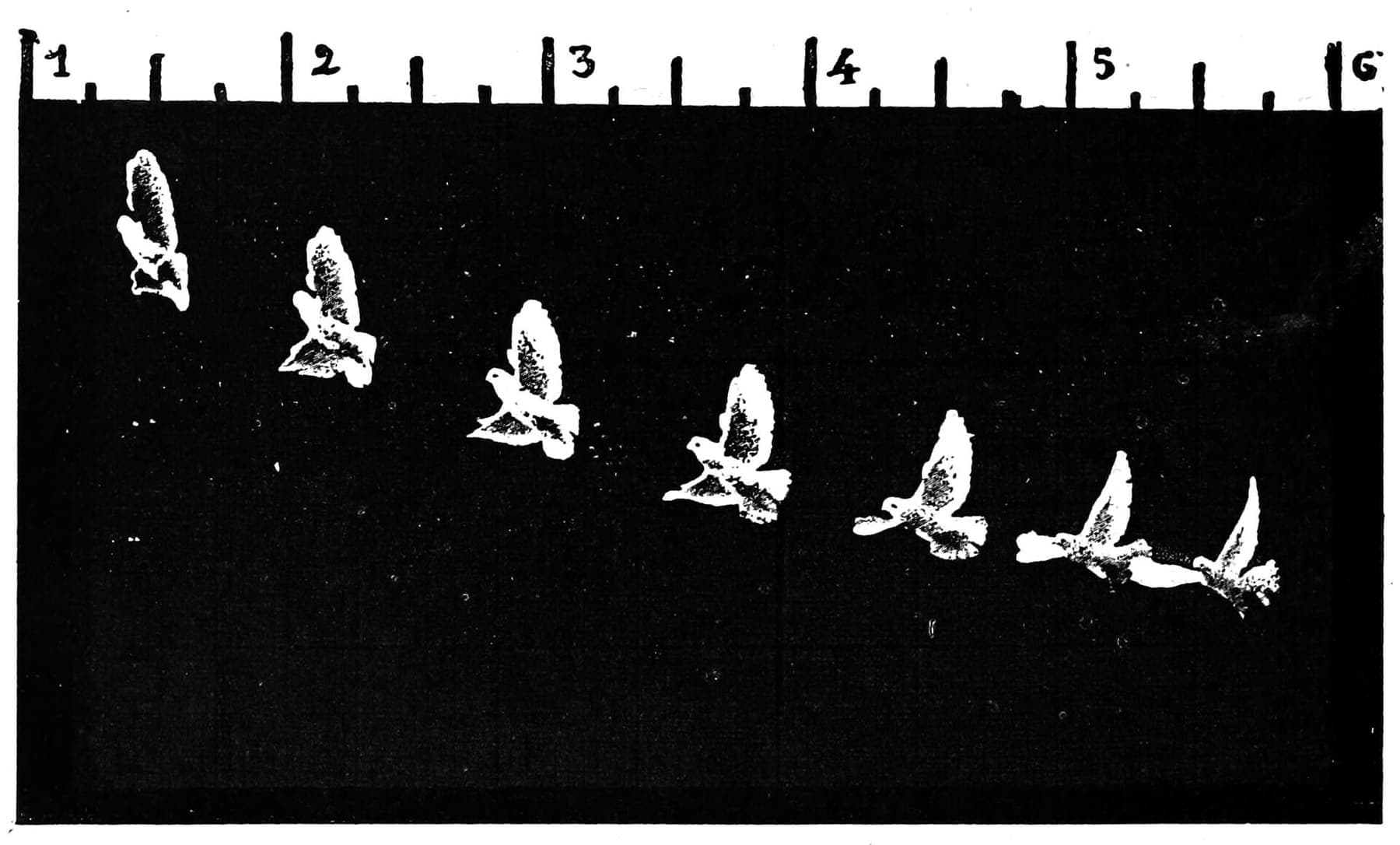
Charles Darwin publishes The Expression of the Emotions in Man and Animals, one of the first scientific books illustrated with photographs, many of them Duchenne's. Expression is argued to be inherited, involuntary and shared across species.
Chronophotograph of a pigeon in flight, against a scale
1886
Desire acquires a clinical vocabulary
Richard von Krafft-Ebing publishes Psychopathia Sexualis, the case-history text that would give clinical names — sadism, masochism — to desires previously without a shared language. The vocabulary outlived the pathology.
1887
The moving body is frozen and read
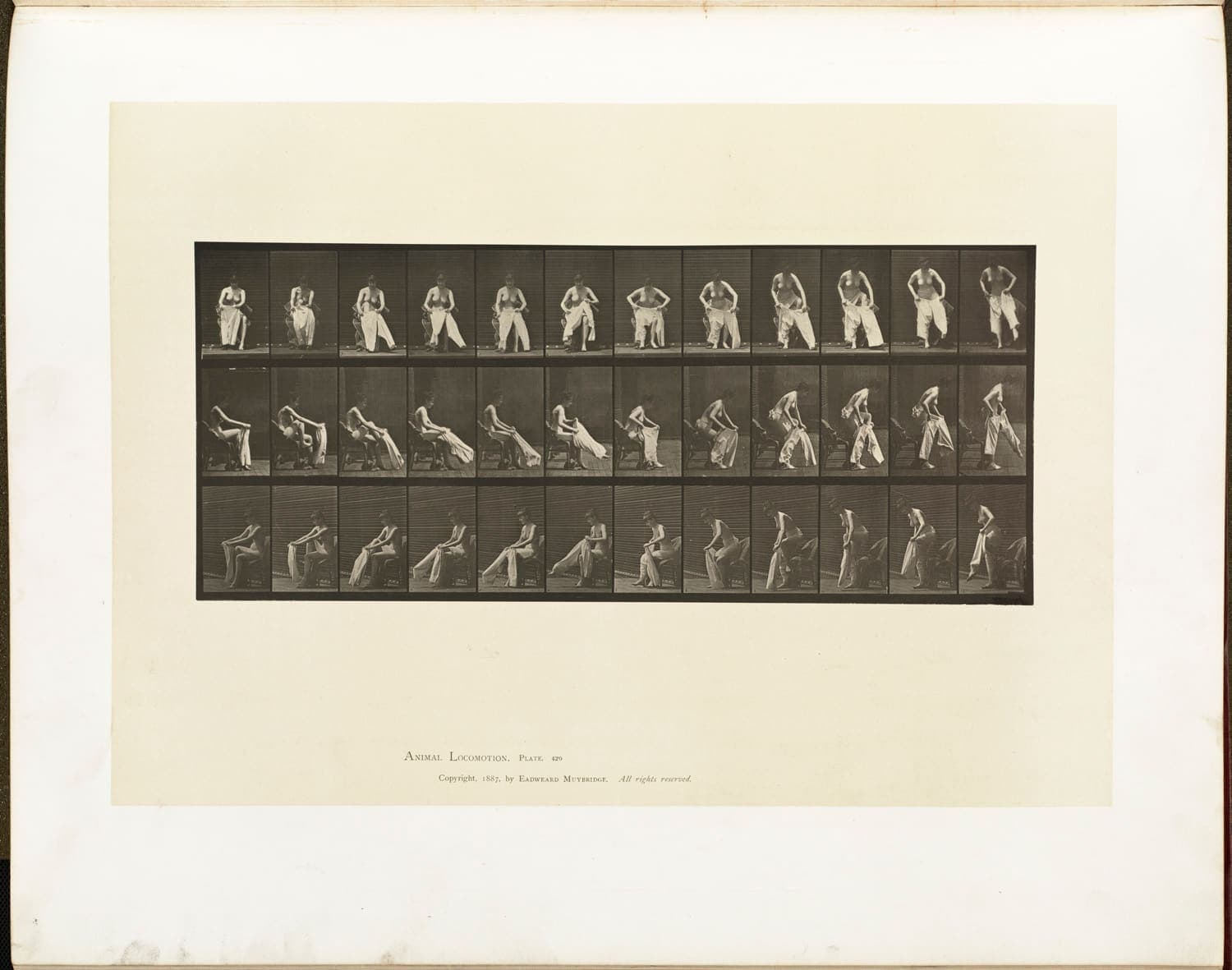
Eadweard Muybridge publishes Animal Locomotion at the University of Pennsylvania: 781 plates of humans and animals photographed in sequence. Movement becomes evidence that can be examined frame by frame.
Animal Locomotion, Plate 420 — rising from a chair
1904
Form is drawn as if it were desire
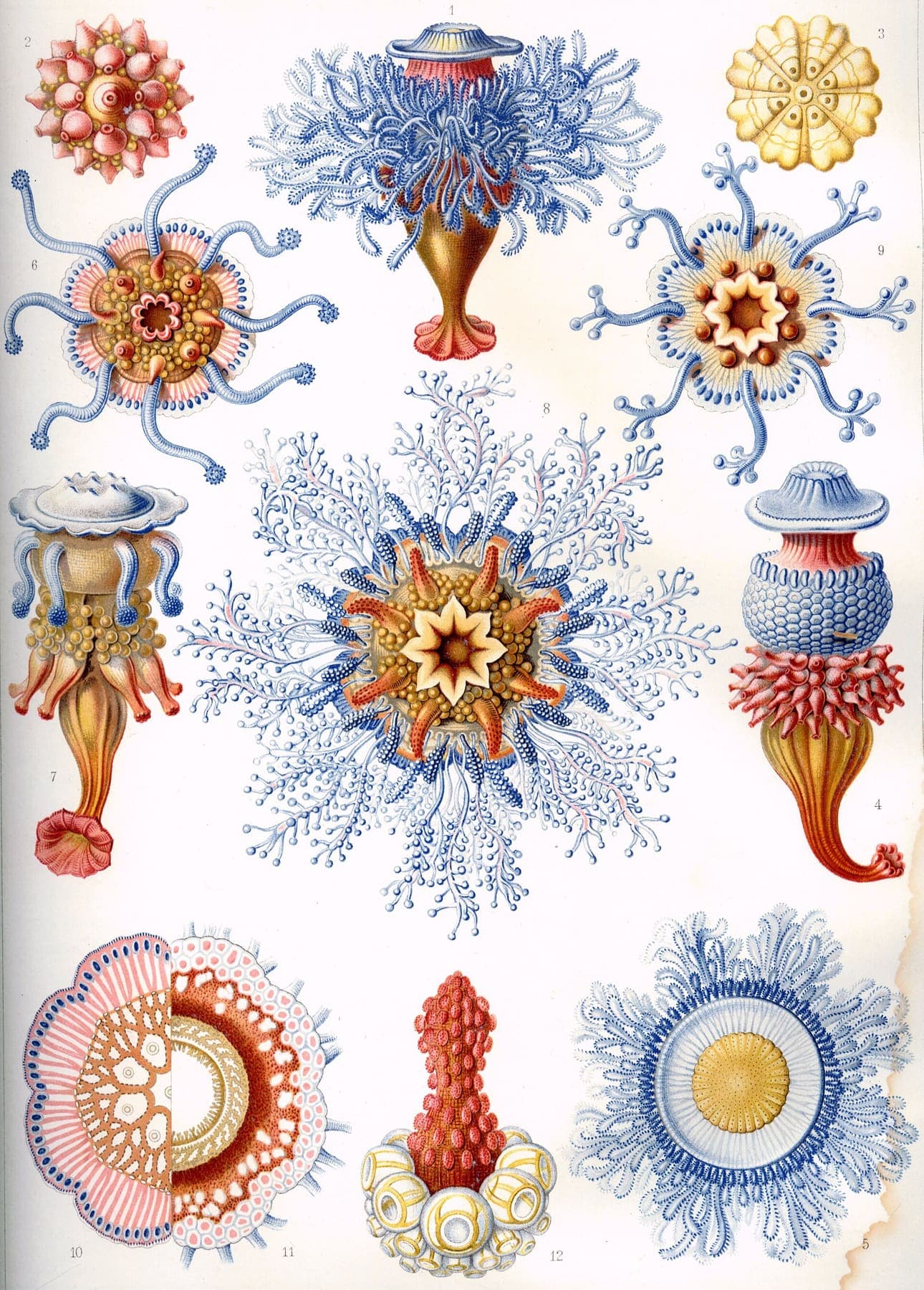
Ernst Haeckel publishes Kunstformen der Natur — lithographs of radiolaria, siphonophores and other microscopic architectures that read as botanical coral. Branching structure becomes an aesthetic as well as a science.
Siphonophorae — Kunstformen der Natur, Plate 17
1906
The neuron doctrine
Santiago Ramón y Cajal shares the Nobel Prize with Camillo Golgi. Cajal's drawings, made over the preceding two decades, establish that nervous tissue is built from discrete cells communicating across gaps rather than a continuous web.
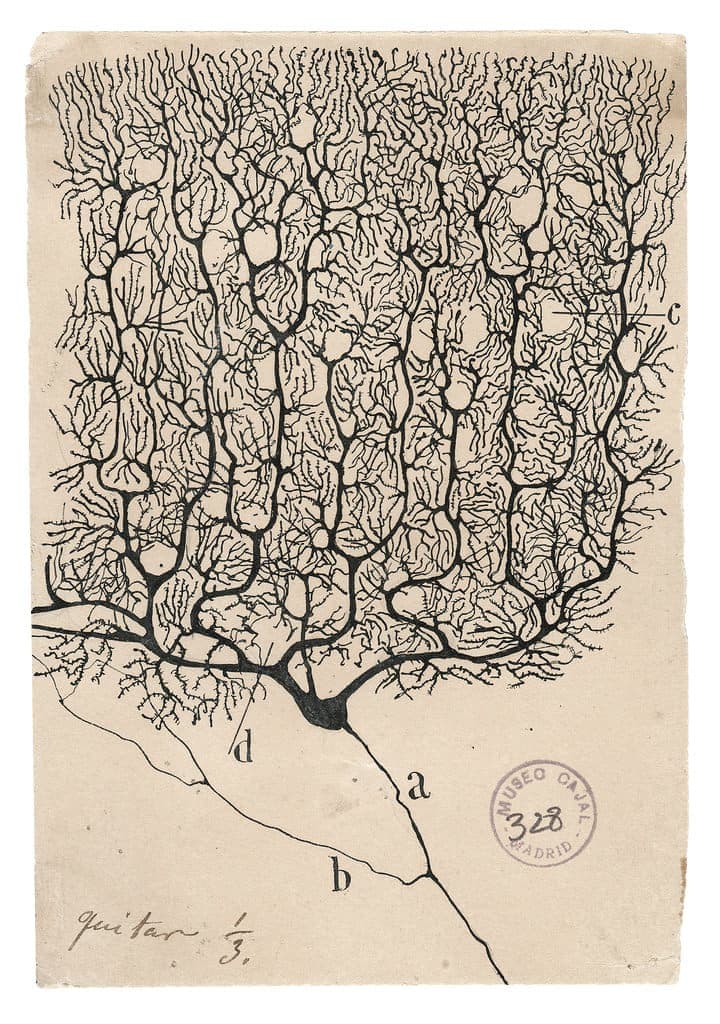
A Purkinje neuron from the human cerebellum
1909
The cortex is partitioned
Korbinian Brodmann publishes his comparative map of the cerebral cortex, dividing it into numbered areas by cellular architecture. The numbering is still in use.
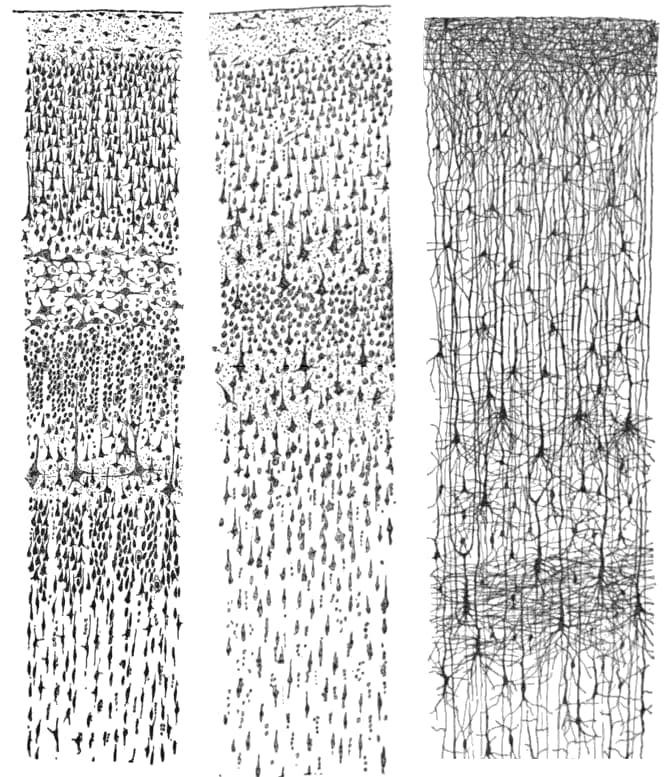
Three drawings of the sensory areas of the human cortex
1921
The vagus speaks in chemistry
Otto Loewi demonstrates that stimulating the vagus nerve releases a substance — 'Vagusstoff', later identified as acetylcholine — that slows a second heart. Neurotransmission is shown to be chemical as well as electrical.
1948
Behaviour is counted
Alfred Kinsey publishes Sexual Behavior in the Human Male, followed in 1953 by the companion volume on the human female. Interview data replaces moral assumption as the description of what people actually do.
1966
Arousal is observed in the laboratory
William Masters and Virginia Johnson publish Human Sexual Response, describing a four-phase model derived from direct physiological measurement rather than self-report.
1994
Safety becomes a physiological state
Stephen Porges introduces the polyvagal theory, proposing that the mammalian autonomic nervous system evaluates safety and threat beneath awareness and that social engagement depends on a distinct vagal pathway.
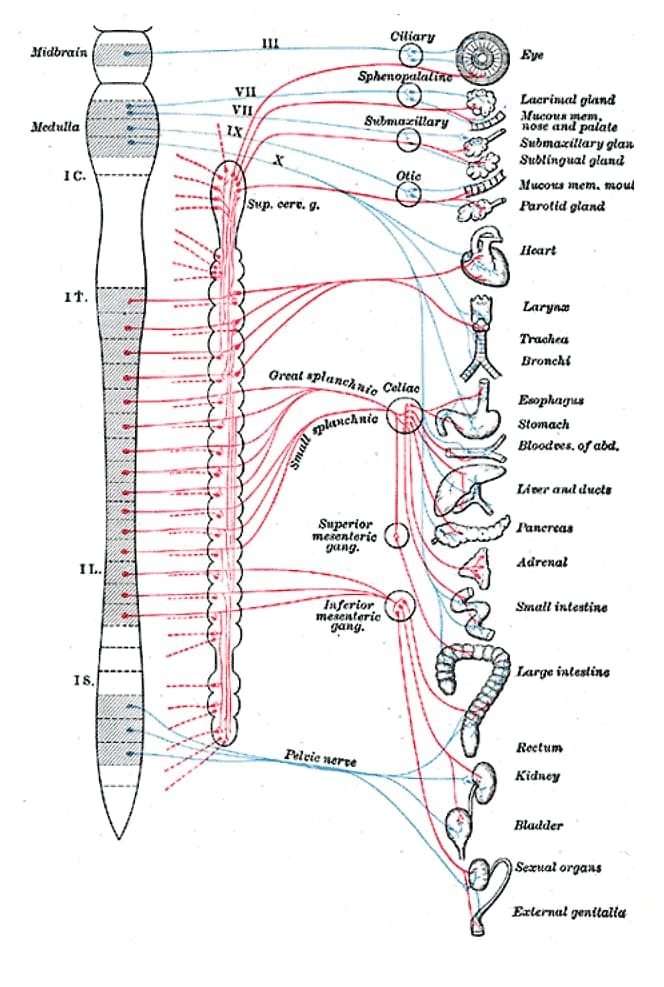
Diagram of the efferent sympathetic and parasympathetic nervous system
2013
Interest is separated from disorder
The fifth edition of the Diagnostic and Statistical Manual distinguishes paraphilias from paraphilic disorders: an atypical sexual interest is not in itself a mental disorder unless it causes distress or harm.
On the imagery
The plates throughout this site are reproduced from public-domain and open-licence collections: archival holdings from the Cajal Institute, the Wellcome Collection, the Metropolitan Museum of Art, the Rijksmuseum, and Wikimedia Commons, alongside contemporary cinematic photography under the Unsplash License. Each figure carries a caption with creator, title, date, institution and licence, and a link to the source record.
Nothing is generated. Treatments — desaturation, a warm cast, inversion of ink drawings — are CSS only. The plate remains the plate.