The parasympathetic case for slowness
Most discourse treats arousal as acceleration. The neuroscience suggests the opposite — that safety, attunement, and deliberate pacing unlock deeper states of pleasure.

Investigations, curricula and a research archive on the neuroscience, psychology and culture of human intimacy — for practitioners who already know the basics.
Most discourse treats arousal as acceleration. The neuroscience suggests the opposite — that safety, attunement, and deliberate pacing unlock deeper states of pleasure.
The Journal
Long-form, sourced, and written for practitioners who already know the basics.
The binary model — ask once, proceed — fails under scrutiny. For experienced practitioners, consent is an ongoing physiological and relational process.
Oxytocin, dopamine, and cortisol interact in ways that explain why structured power exchange can feel profoundly bonding — and why it can go wrong.
Submission and dominance are not merely roles. They engage distinct cognitive networks — with implications for how we design scenes and debrief afterward.
Whole-body arousal maps poorly onto mainstream models. Interoception — reading internal signals — is a trainable skill central to advanced practice.
Aftercare is not optional kindness. It is the physiological off-ramp from intense autonomic activation — and it looks different for every nervous system.
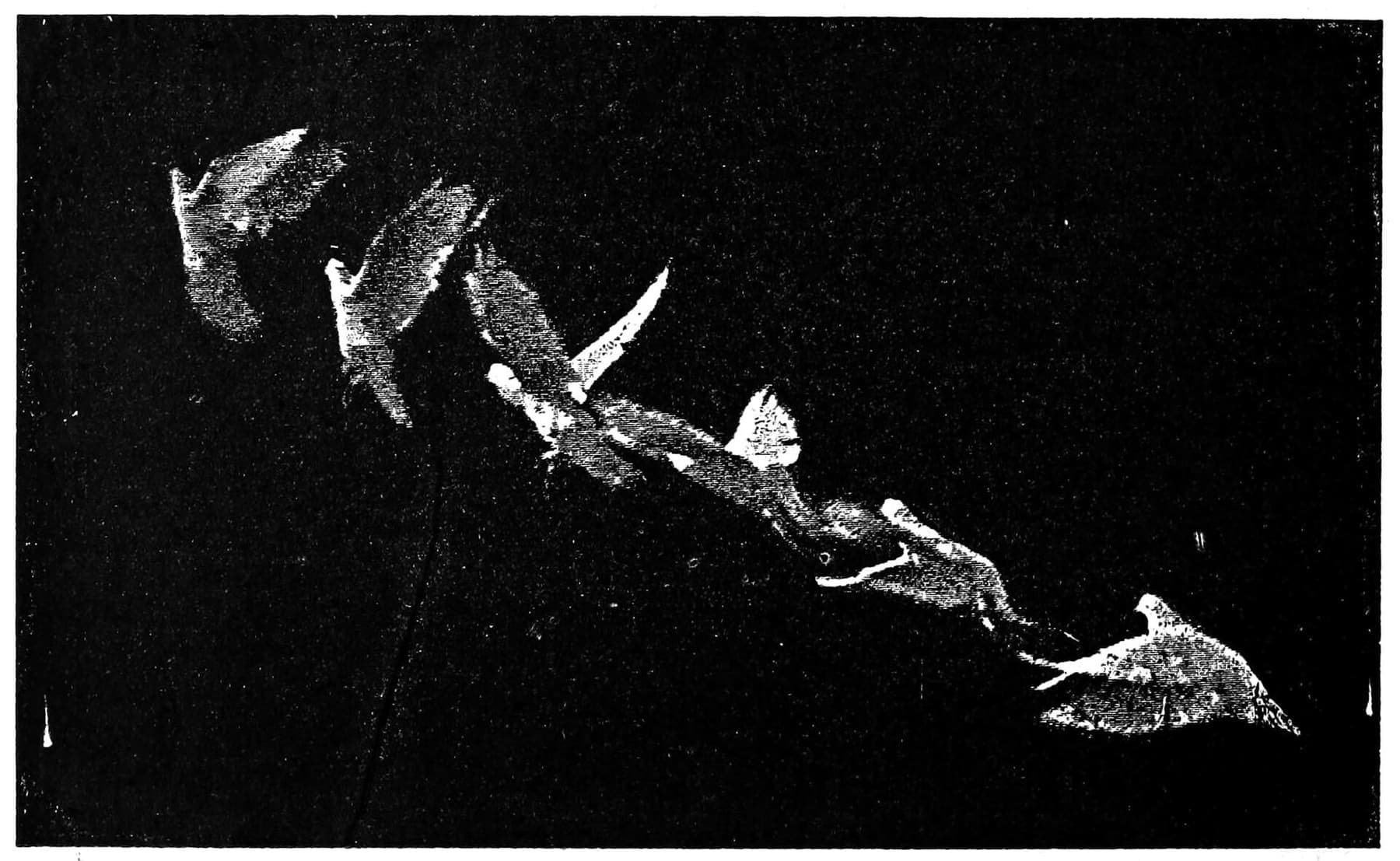
Étienne-Jules Marey, 1885. Wikimedia Commons. Public domain.
The Academy
Structured courses on consent, communication, neuroscience and risk-aware practice. Free introductory lessons; the depth is for members.
Design scenes with intention — pacing, sensation layering, psychological depth, and nervous-system-aware structure.
Move beyond the checkbox model. Learn to read, negotiate, and maintain consent in real time.

D/s as relationship infrastructure, life changes, jealousy, compersion, and long-term dynamic health.

Structured frameworks for pre-scene negotiation, boundary mapping, and ongoing communication.
Lines of inquiry
Every published item belongs to a line of inquiry. Each has its colour; colour appears nowhere else.
Autonomic states, neurochemistry, interoception and the architecture of arousal — read from the tissue up.
Attachment, executive load, subspace and drop; shame, trauma and the long work of integration.
Negotiation, renegotiation, autonomic tells and the infrastructure of the debrief.
Sensation, restraint, impact, aftercare and first aid — technique held to the standard of evidence.
The Lexicon
Open →111 defined terms, cross-referenced from every lesson.
Chronology
Full chronology →The body was measured, drawn, electrified and photographed long before it was allowed to be understood.
1543
The body becomes something you can look at
1886
Desire acquires a clinical vocabulary
1921
The vagus speaks in chemistry
2013
Interest is separated from disorder
NeuraKink publishes at the intersection of neuroscience, psychology and kink-positive practice. No satire. No dumbed-down 101. Rigorous, sourced exploration of what desire actually is — and a standing invitation to keep reading.