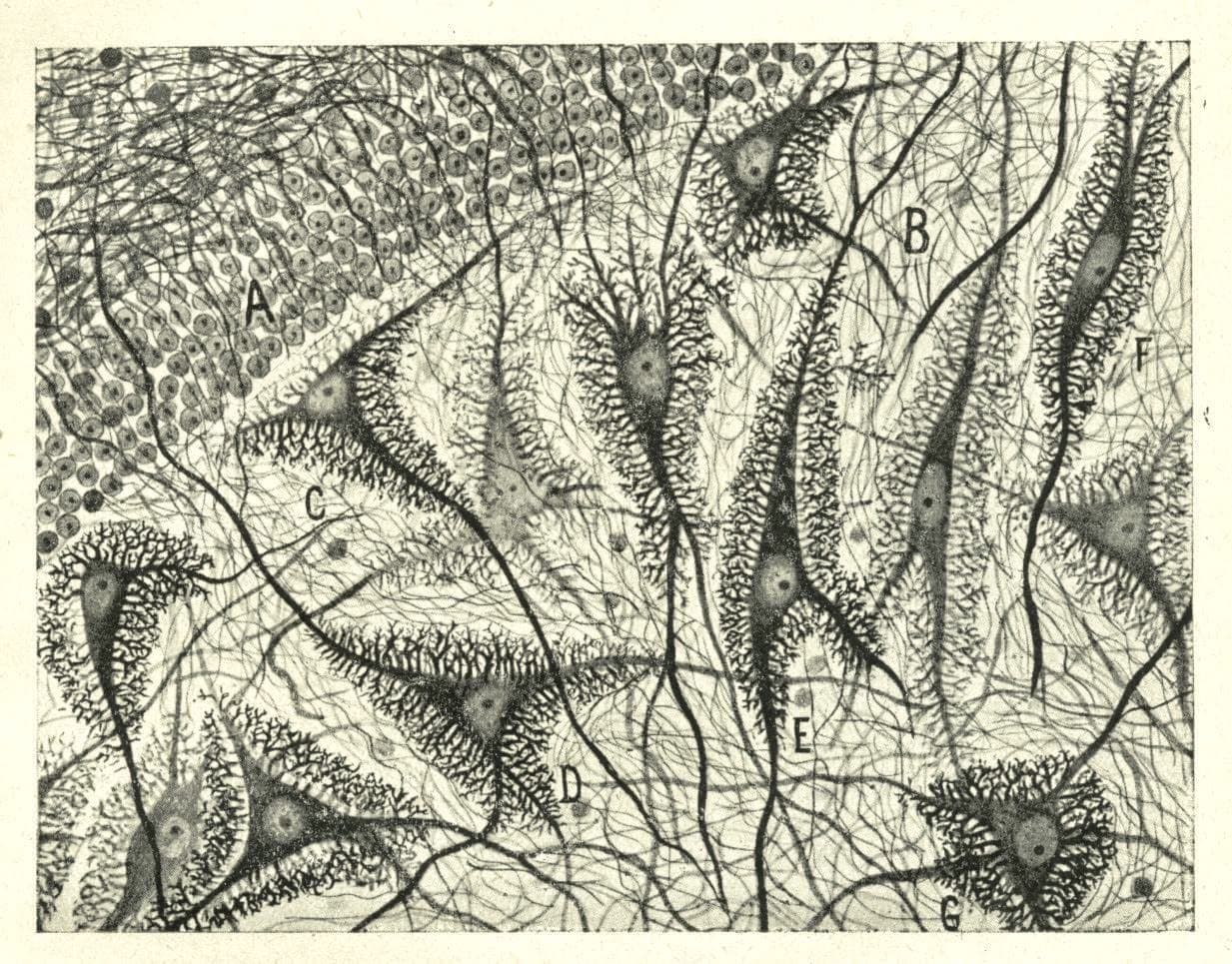
Power exchange and the prefrontal cortex
Submission and dominance are not merely roles. They engage distinct cognitive networks — with implications for how we design scenes and debrief afterward.
Dr. Mira Chen
Psychology Editor
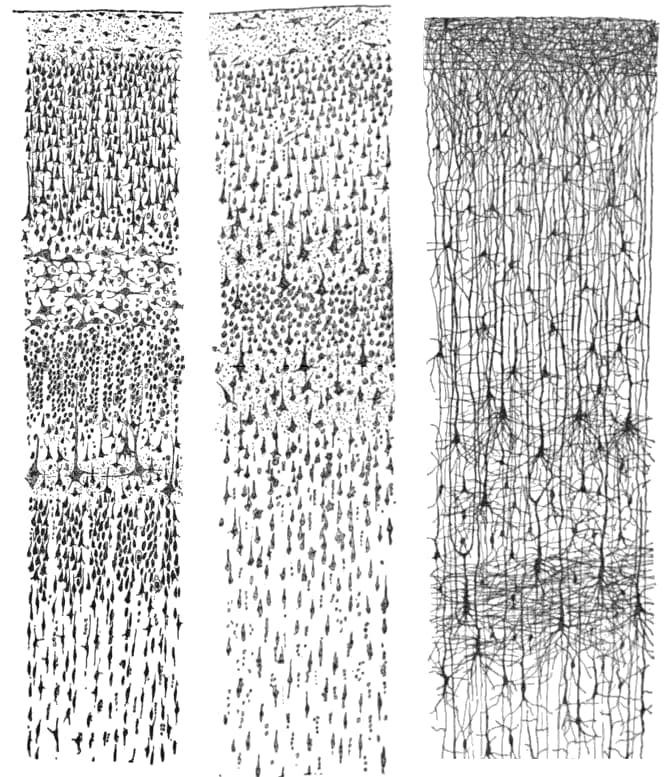
Plate I — Three drawings of the sensory areas of the human cortex
The popular image of submission as "turning off the brain" is neurologically inaccurate. Subspace — when it occurs — involves complex shifts across multiple cortical and subcortical systems, not a simple shutdown.
Dominance as executive load
Topping is cognitively demanding. Effective dominants maintain situational awareness, track multiple streams of feedback, manage timing and intensity, and hold psychological container — simultaneously. This engages executive function networks in the prefrontal cortex and anterior cingulate.
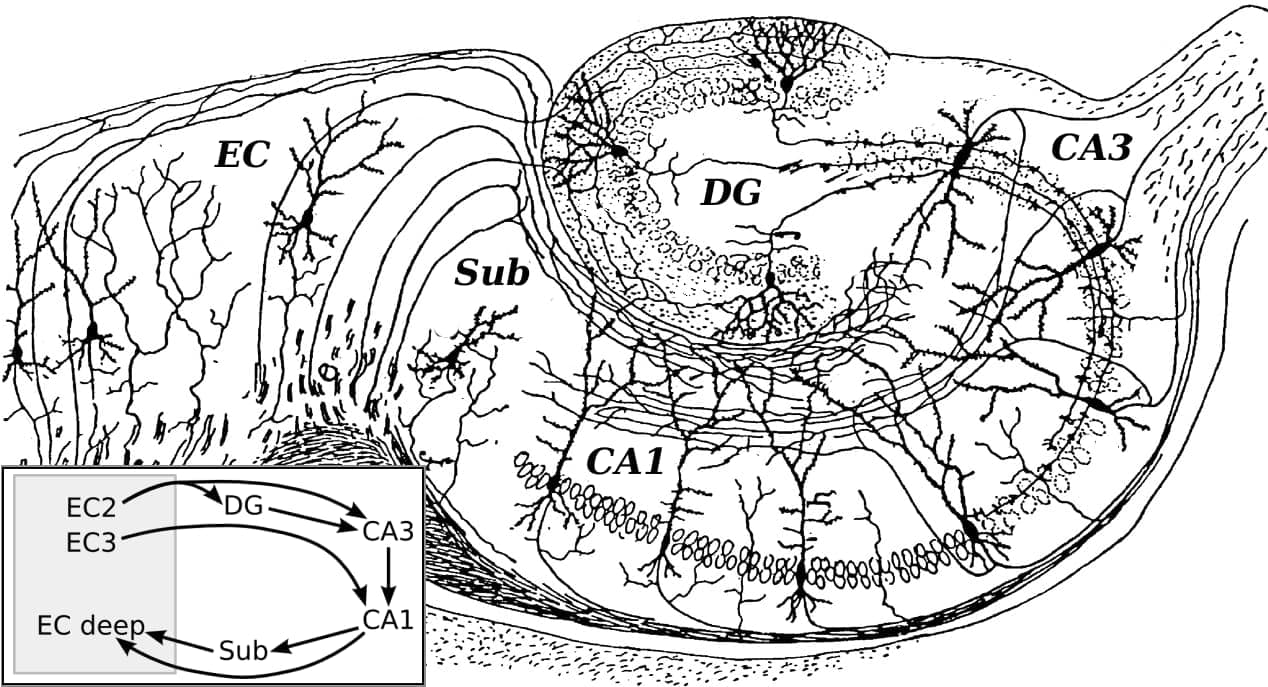
Cajal’s circuitry of the hippocampus, 1911. Layered, dense, and busy — a fair picture of what a top's prefrontal cortex is doing forty minutes into a scene: holding sequence, reading feedback, filing what just happened.
Fatigue in long scenes is not weakness. It is cognitive load. Experienced tops plan for it: shorter intense segments, co-topping, explicit handoff protocols.
Submission as selective disinhibition
Submission, conversely, often involves reduced prefrontal inhibition of somatosensory and emotional processing — not absence of cognition, but redistribution of it. Bottoms frequently report heightened body awareness and reduced self-narrative chatter. This maps onto decreased default mode network activity observed in some meditative and flow states.
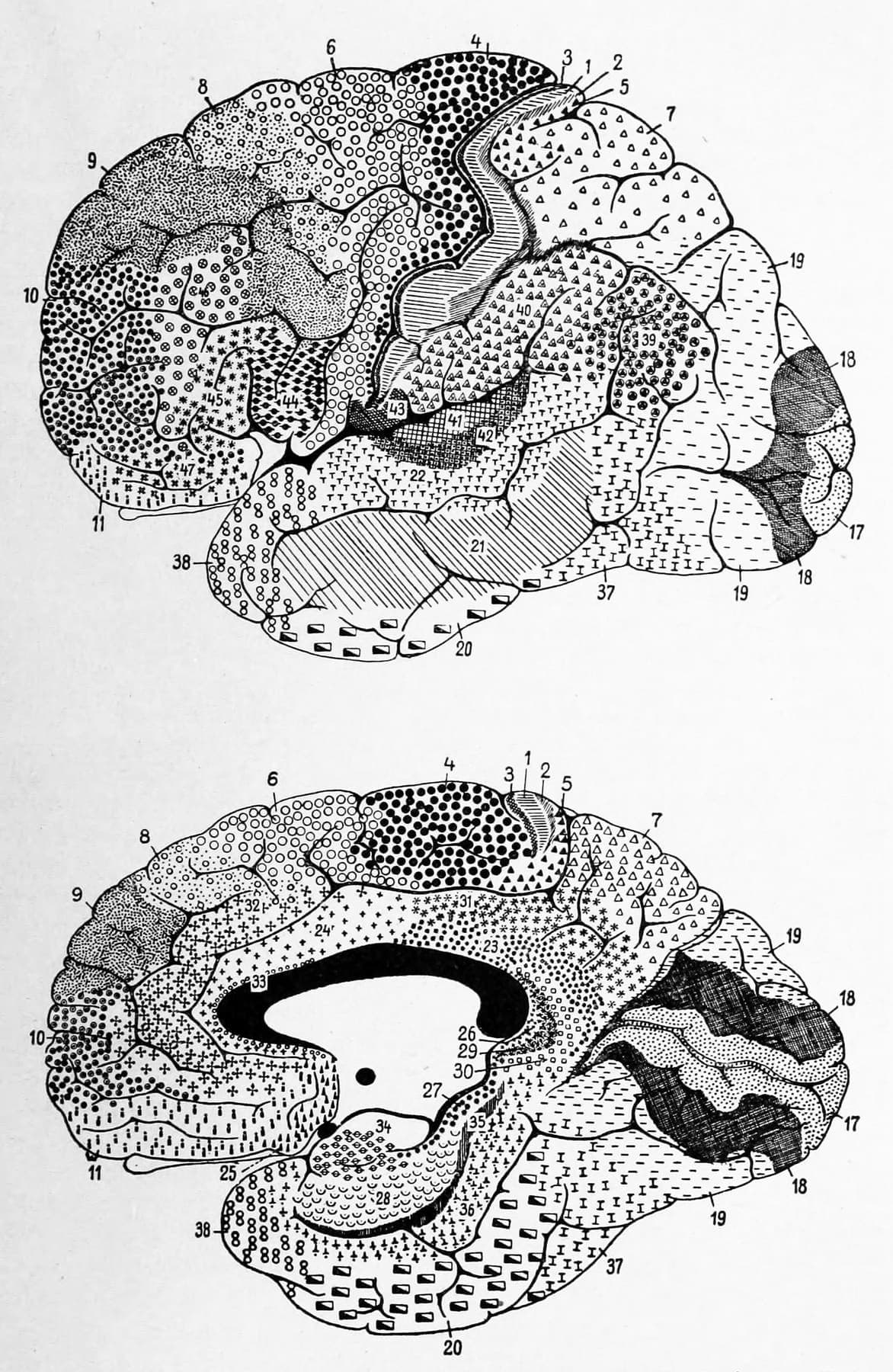
Brodmann’s cortical fields, 1909. The numbering is still in use — a reminder that architecture matters, even if faculties do not live in tidy compartments. Subspace is not a region going dark; it is a network changing its weighting.
The implication: subspace is not an excuse for poor negotiation beforehand. It is a state that makes real-time renegotiation harder, which is why pre-negotiation and check-in structures matter more, not less.
Debrief as cognitive integration
Post-scene debrief supports memory consolidation and emotional integration — hippocampal and prefrontal processes that help the brain "file" intense experience. Skipping debrief leaves experiences unintegrated, which over time contributes to relationship friction and personal distress.
Build debrief into your practice the way you build warm-up into impact play: non-optional, skill-based, improvable.
- Dr. Mira Chen — Psychology Editor
- 11 minutes
- None cited
- Three drawings of the sensory areas of the human cortex — Santiago Ramón y Cajal, 1899. Wikimedia Commons. Public domain.
- Neural circuitry of the rodent hippocampus — Santiago Ramón y Cajal, 1911. Wikimedia Commons. Public domain.
- The cortical fields of the lateral and medial hemispheric surface of humans — Korbinian Brodmann, 1909. Wikimedia Commons. Public domain.
Continue the inquiry
Related investigations
The parasympathetic case for slowness
Most discourse treats arousal as acceleration. The neuroscience suggests the opposite — that safety, attunement, and deliberate pacing unlock deeper states of pleasure.
Consent as a continuous practice
The binary model — ask once, proceed — fails under scrutiny. For experienced practitioners, consent is an ongoing physiological and relational process.

The neurochemistry of trust in power exchange
Oxytocin, dopamine, and cortisol interact in ways that explain why structured power exchange can feel profoundly bonding — and why it can go wrong.