Reading arousal beyond the genitals
Whole-body arousal maps poorly onto mainstream models. Interoception — reading internal signals — is a trainable skill central to advanced practice.
Avery Holt
Practice Editor
Plate I — Chronophotograph of a pigeon taking flight
Genital-centric models of arousal fail most kink practitioners on first contact. Arousal is whole-body, context-dependent, and frequently non-linear.
Interoception as core skill
Interoception — the sense of the internal state of the body — varies enormously between individuals. Research links interoceptive accuracy to emotional regulation, empathy, and sexual satisfaction. It is also trainable: breathwork, body scans, mindful movement, and certain types of bondage all increase interoceptive awareness over time.
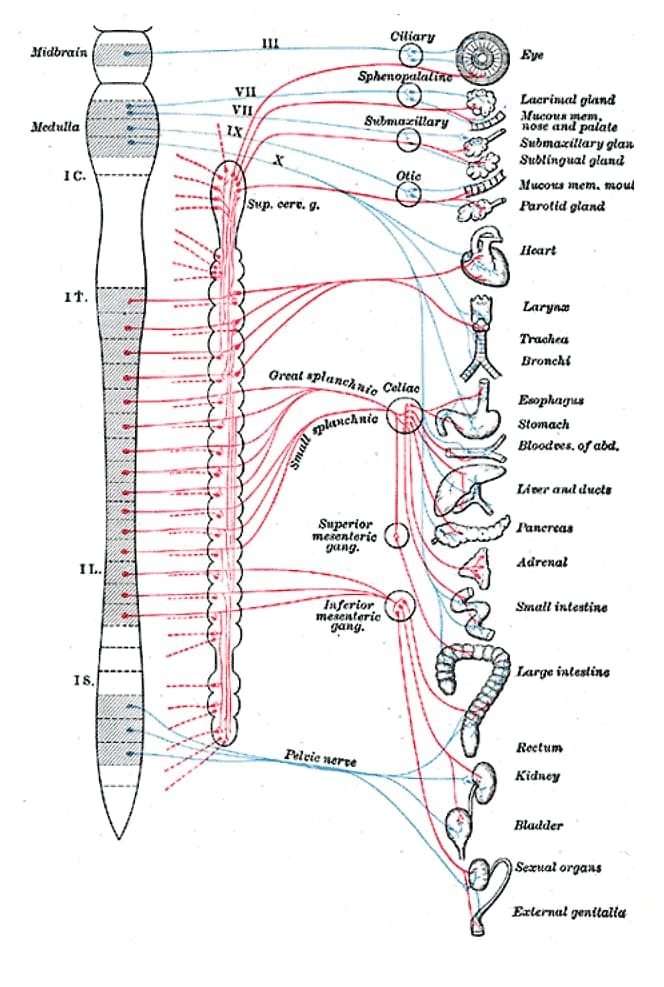
Gray's autonomic diagram, 1918. The body as a system you can walk around and read — sympathetic and parasympathetic branching like a map. Interoception is learning to read it from inside.
For experienced practitioners, "reading the room" is reading interoceptive signals in another body: skin temperature shifts, micro-tremors, changes in vocal pitch, the quality of stillness versus freeze.
Non-genital arousal pathways
Nipple stimulation, impact, rope compression, and psychological dominance all activate arousal pathways that bypass genital-centric models entirely. Spinal reflex arcs, vagus nerve stimulation, and cortical association areas contribute to arousal profiles that standard sex education never maps.
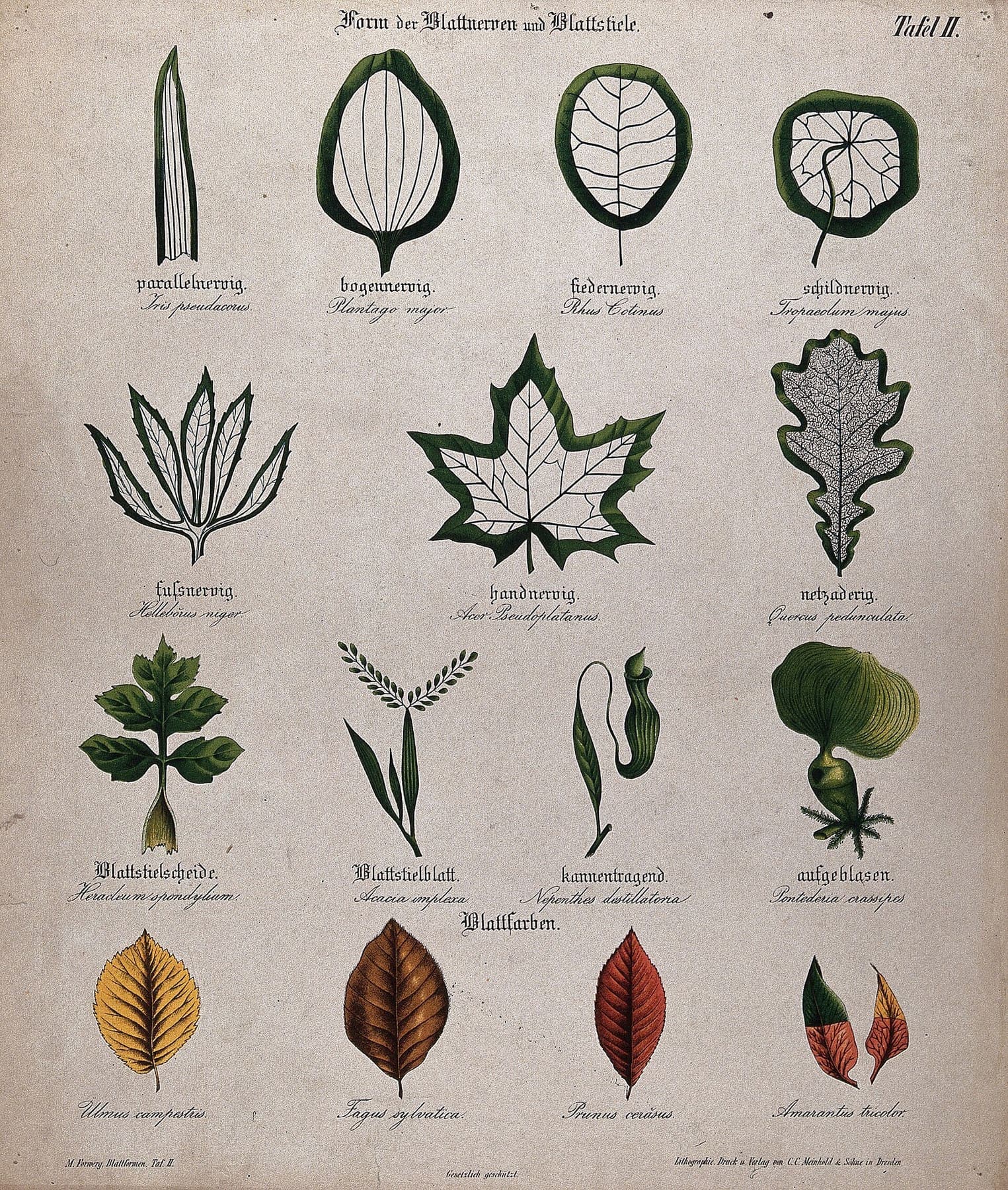
Leaf venation as mapped by nineteenth-century botany. Branching, anastomosis, quiet density — a fair picture of how sensation travels. Most of what the body reports never passes through the parts of it that sex education bothers to label.
This is not edge-case trivia. It is the normal physiology of a significant portion of kink practice.
Practical application
- Build scenes around sensation diversity, not genital escalation
- Teach partners to report internal states, not just "more" or "less"
- Treat anorgasmic or non-genital climax as valid endpoints, not failures
NeuraKink publishes for people who already know the basics. This is the level of conversation we exist to host.
- Avery Holt — Practice Editor
- 9 minutes
- None cited
- Chronophotograph of a pigeon taking flight — Étienne-Jules Marey, 1883. Wikimedia Commons. Public domain.
- Diagram of the efferent sympathetic and parasympathetic nervous system — Henry Vandyke Carter, 1918. Wikimedia Commons. Public domain.
- Fifteen plant leaves with different types of venation — Unknown engraver, 19th century. Wellcome Collection, London. CC BY 4.0.
Continue the inquiry
Related investigations
Aftercare as nervous system regulation
Aftercare is not optional kindness. It is the physiological off-ramp from intense autonomic activation — and it looks different for every nervous system.
The parasympathetic case for slowness
Most discourse treats arousal as acceleration. The neuroscience suggests the opposite — that safety, attunement, and deliberate pacing unlock deeper states of pleasure.
Consent as a continuous practice
The binary model — ask once, proceed — fails under scrutiny. For experienced practitioners, consent is an ongoing physiological and relational process.